

If you want to make it in real estate investing, you either need a lot of cash to sink into turn-key properties with little gain, or you need to buy low and add value. If you are like me, you are looking for value-adds. Uncover them and increase the value of your property for that eventual sale. If you never plan to sell, you don’t want the value-adds (property taxes go up), and you aren’t really an investor.
There are a bunch of value-adds but the rent spread is an often overlooked and free way to quickly increase income and value. Here’s how to do it.
How to Look for the Rent Spread
Consider two 8-unit properties which are similar. They each have eight 700 square foot two bedroom, one bathroom units. They are in similar locations and have similar amenities. You calculate that the market rent for these units is $750 a month. When you start to evaluate these properties you receive the rent rolls from the seller.
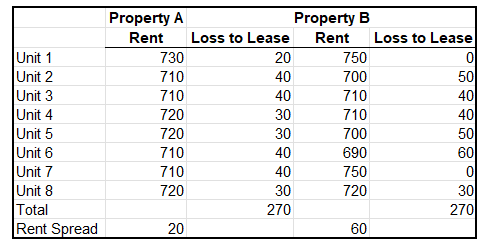
You generate your own spreadsheet to compare. You put down all the rents and then subtract them from the market rent, which leaves Loss to Lease, or the monthly loss the unit takes every month it is not getting market rent. Property A has loss to lease of up to $40 per unit and it goes up to $60 on property B.
You might target getting the rents up as a goal of your property. That’s a good thing to do, and if you were able to get them all up to market, you’d receive the total loss to lease every month. At $270, they are equal in A and B. Don’t forget that you need to look at when the leases end because you won’t be able to increase the rent until their lease is up for renewal. But that isn’t important in the rent spread. Which property is the better purchase?
What is the Rent Spread?
Rent Spread is the highest rent minus the lowest rent in similar units. In property A, the highest is $730 and the lowest is $710. In B it’s $750 and $690. How long to you think the tenant has been in the $690 unit? Probably many years. These units are ones where the owner likes the tenant (because they pay on time or for some other reason) and don’t want to upset them and make them leave by increasing the rent. But right next to the $690 unit is a $750 unit. You can guess that lease was recently signed. What this tells you is that the property is able to sustain the higher rents. You don’t know this with Property A. If any of those leases were recently signed or re-leased (also a clue), then you may predict difficulty bringing up tenants to $750.
The rent spread is also a way to look at how the current owner has been managing the property. A larger rent spread may indicate lack of attention and potentially other value-add areas. The greater the spread, the greater the value-add usually. At the very least, you need to be asking the seller why the lowest rents are so low.
You should calculate rent spread on all your potential deals. Just because it is a high spread doesn’t mean you should purchase, but it does warrant a closer look.